
Naval Architecture Terminology: Precision for Luxury Yachts

Luxury yacht design demands flawless communication of specialized terminology that sets apart American engineering standards from European or Asian approaches. For owners and designers working on custom projects, mastering naval architecture vocabulary is essential to achieving technical precision and performance excellence. With over 90 percent of global superyacht builds involving multinational teams, a clear grasp of key terminology streamlines collaboration and helps transform ambitious concepts into seaworthy masterpieces.
Table of Contents
Key Takeaways
Point | Details |
Naval Architecture Integration | Naval architecture merges scientific methodology with creative problem-solving to design seaworthy vessels, addressing key factors like structural integrity and stability. |
Hull Design Importance | The choice of hull form significantly impacts vessel performance, stability, and aesthetic appeal, necessitating careful computational modeling and testing. |
Stability and Performance Metrics | Understanding stability, trim, and balance is crucial for ensuring yacht safety and optimized performance across diverse maritime conditions. |
Regulatory Compliance | Adhering to international classification standards and regulations is essential for ensuring safety and operational integrity in yacht design and construction. |
Defining Naval Architecture Terminology Clearly
Naval architecture represents a sophisticated engineering discipline focused on designing watercraft that seamlessly integrate technical precision with functional excellence. At its core, naval architecture combines scientific methodology and creative problem solving to transform conceptual yacht designs into seaworthy masterpieces. Modern naval architects handle complex calculations addressing economic viability, structural integrity, and stability while ensuring compliance with international maritime regulations.
The discipline encompasses a comprehensive workflow that extends far beyond traditional shipbuilding techniques. Naval architects must synthesize multiple engineering domains - including hydrodynamics, materials science, mechanical engineering, and structural analysis - to create vessels that perform optimally under diverse maritime conditions. Their work involves intricate computational modeling, advanced simulation technologies, and detailed stress analysis to predict vessel behavior across different environmental scenarios.
Understanding naval architecture terminology requires recognizing its multifaceted nature. Key components include hull design, propulsion systems, structural engineering, stability calculations, and performance optimization. Luxury yacht designers specifically focus on balancing technical requirements with aesthetic considerations, creating vessels that are not just functional marine platforms but also floating expressions of engineering artistry. Each design iteration involves precise mathematical modeling to ensure structural soundness, fuel efficiency, maneuverability, and passenger comfort.
Pro Tip: When discussing naval architecture projects, always clarify the specific design parameters and performance requirements to ensure precise communication between engineers, designers, and clients.
Key Hull Forms and Hydrodynamic Terms
Hull design represents the foundational element of naval architecture, where form meets function in marine engineering. Hull form optimization requires intricate computational modeling and physical testing to achieve peak performance across diverse maritime conditions. Naval architects meticulously analyze factors like displacement, stability, seakeeping qualities, and propulsion efficiency when crafting vessel geometries that balance technical requirements with aesthetic considerations.

Luxury yacht designers distinguish between several primary hull forms, each with unique hydrodynamic characteristics. Displacement hulls represent traditional designs where the vessel moves through water by pushing liquid aside, typically used in slower, more stable watercraft. Planing hulls, conversely, are engineered to rise above water at high speeds, reducing drag and increasing fuel efficiency. Semi-displacement hulls offer a hybrid approach, combining elements of both design philosophies to create versatile marine platforms that adapt to varied performance needs.
Here’s a comparison of common yacht hull forms and their performance characteristics:
Hull Form | Typical Speed Range | Stability Level | Optimal Condition |
Displacement | Up to 20 knots | High | Calm and rough seas |
Planing | 20-50+ knots | Moderate to low | Calm, protected waters |
Semi-Displacement | 15-30 knots | Balanced | Mixed sea states |
Hydrodynamic terminology encompasses a complex lexicon of technical concepts critical for understanding vessel performance. Key terms include wetted surface area (the hull portion in direct water contact), block coefficient (a measure of hull volume efficiency), and prismatic coefficient (indicating hull fullness and shape). These calculations help naval architects predict vessel behavior, optimize propulsion systems, and ensure structural integrity across different maritime environments. Computational fluid dynamics (CFD) simulations have revolutionized hull design, allowing engineers to model intricate water interactions with unprecedented precision.
Pro Tip: When evaluating yacht hull designs, always request comprehensive performance data that demonstrates stability, fuel efficiency, and seakeeping capabilities across multiple maritime conditions.
Understanding Stability, Trim, and Balance
Stability represents the fundamental cornerstone of naval architecture, determining a vessel’s ability to maintain equilibrium and safety under varying maritime conditions. Stability calculations involve complex mathematical models that assess a yacht’s capacity to resist external forces, including wind, waves, and weight distribution. Naval architects employ sophisticated techniques like metacentric height analysis and inclining experiments to ensure vessels can withstand challenging environmental scenarios while providing optimal passenger comfort and safety.
The concepts of trim and balance are intricately interconnected in yacht design. Trim refers to the vessel’s longitudinal orientation relative to the water line, which directly impacts performance, fuel efficiency, and passenger experience. Negative trim occurs when the bow sits lower in the water, while positive trim lifts the bow, potentially reducing water resistance. Luxury yacht designers meticulously balance these factors, considering weight distribution, fuel load, passenger placement, and dynamic maritime conditions to achieve ideal vessel positioning.
Multiple factors influence a yacht’s stability and performance characteristics. Key considerations include the vessel’s center of gravity, hull shape, weight distribution, and operational parameters. Naval architects utilize advanced computer modeling and physical simulations to predict how different design elements will impact overall vessel behavior. Critical stability parameters such as the righting moment (a vessel’s ability to return to an upright position after external forces) and transverse stability help engineers create vessels that can navigate diverse maritime environments with confidence and precision.
Pro Tip: Always request a comprehensive stability analysis report when evaluating yacht designs, focusing on performance metrics across multiple maritime conditions and load scenarios.
Performance Metrics and Design Parameters
Advanced yacht design metrics represent a sophisticated intersection of data analytics, computational modeling, and engineering precision. Naval architects leverage complex performance metrics to transform conceptual designs into world-class maritime vessels that balance technical excellence with aesthetic sophistication. These metrics encompass a comprehensive range of parameters including hydrodynamic efficiency, propulsion system optimization, structural integrity, and energy consumption analysis.
Critical performance parameters for luxury yacht design extend far beyond traditional maritime engineering considerations. Key performance indicators include fuel efficiency, maximum and cruising speeds, range of operation, maneuverability, vibration characteristics, and environmental impact. Naval architects employ advanced simulation technologies to model intricate interactions between hull geometry, propulsion systems, and maritime environmental conditions. These computational models enable precise predictions of vessel behavior across diverse operational scenarios, allowing designers to optimize every aspect of yacht performance before physical construction begins.
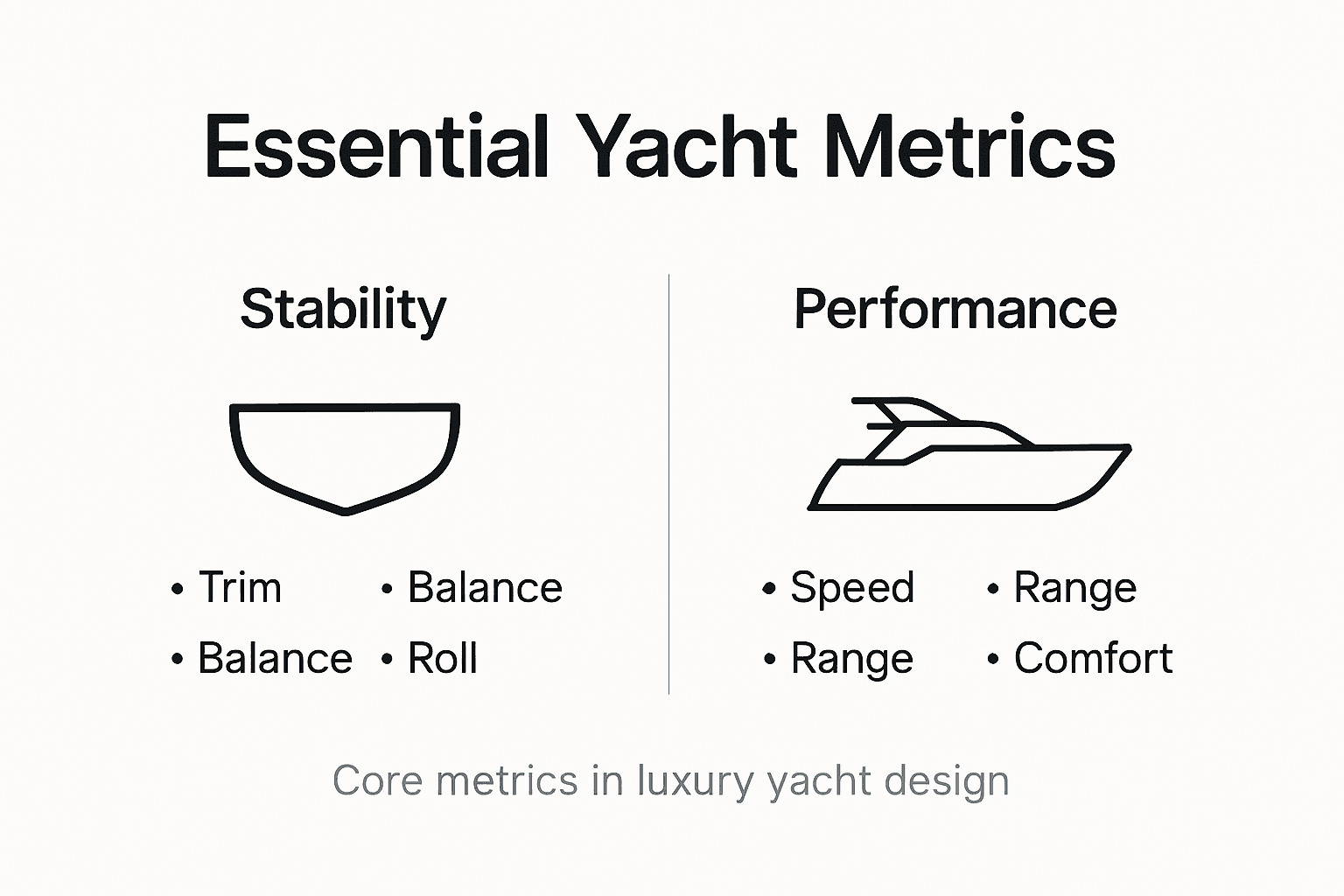
The design parameters for modern luxury yachts integrate multiple engineering disciplines, combining computational fluid dynamics, materials science, structural engineering, and advanced analytics. Designers analyze complex variables such as weight distribution, center of gravity, hydrodynamic resistance, propulsion efficiency, and structural loading. Sophisticated business intelligence tools and data analytics platforms enable naval architects to simulate and predict performance outcomes with unprecedented accuracy, reducing potential design errors and minimizing costly modifications during the construction phase.
Pro Tip: Request a comprehensive performance simulation report that includes detailed computational models demonstrating the yacht’s behavior across multiple maritime conditions and operational scenarios.
Regulatory and Classification Terms for Yachts
Classification rules for yachts represent a complex framework of international maritime regulations designed to ensure safety, performance, and structural integrity across luxury vessel designs. These comprehensive standards encompass multiple dimensions of yacht engineering, from initial conceptual design through final construction and ongoing maintenance. Naval architects must navigate an intricate landscape of regulatory requirements that address vessel size, material specifications, structural engineering, safety systems, and environmental compliance.
Yacht classification involves a rigorous assessment process conducted by specialized marine certification organizations. These entities evaluate vessels across multiple critical parameters, including hull strength, propulsion systems, navigation equipment, fire safety protocols, and environmental impact considerations. Different classification levels exist for various yacht categories, ranging from pleasure craft to commercial vessels, each with unique regulatory benchmarks that demand meticulous engineering precision and compliance documentation.
The international maritime regulatory framework includes multiple key organizations that establish and enforce yacht classification standards. The primary global entities include the International Maritime Organization (IMO), Lloyd’s Register, Bureau Veritas, and the American Bureau of Shipping (ABS). These organizations develop comprehensive technical standards that address structural integrity, safety protocols, environmental regulations, and operational requirements. Yacht designers must demonstrate compliance through extensive documentation, computational modeling, physical testing, and ongoing verification processes that ensure vessels meet the most stringent international maritime standards.
Below is a summary of yacht regulatory bodies and their primary focus areas:
Organization | Main Focus | Geographic Scope | Key Role |
International Maritime Org. | Global standards | Worldwide | Safety, environment policies |
Lloyd’s Register | Certification | International | Structural compliance |
Bureau Veritas | Technical rules | Europe, Global | Performance, safety |
American Bureau of Shipping | US-centric rules | Americas, Global | Design approval |
Pro Tip: Always engage a specialized maritime legal consultant to review classification requirements specific to your yacht’s intended operational region and usage category.
Elevate Your Luxury Yacht Design with Precision Naval Architecture
Navigating the complex terminology and technical challenges of naval architecture is crucial when designing a luxury yacht that meets the highest standards of stability, performance, and aesthetic excellence. Concepts like hull forms, stability calculations, and regulatory compliance can feel overwhelming, but they are essential to crafting vessels that combine safety and innovation. If you seek to transform these intricate ideas into a bespoke, cutting-edge yacht, Opalinski Design House offers the expertise and visionary solutions that bridge technical precision with creative artistry.
Take the next step toward your dream yacht with a team pioneering patented innovations such as fold-down transoms and rotational bulkheads for large vessels. Don’t compromise when it comes to stability, hydrodynamics, or compliance with classification rules. Visit Opalinski Design House now to explore how their comprehensive naval architecture and yacht design services ensure your vessel excels in performance, comfort, and style. Contact their experts today to receive a personalized consultation and bring your luxury yacht vision to life.
Frequently Asked Questions
What is naval architecture?
Naval architecture is an engineering discipline focused on designing watercraft, combining scientific methods and creative problem-solving to create functional and aesthetically pleasing vessels.
What are the main types of hull forms in yacht design?
The primary hull forms include displacement hulls, which are designed for stability at lower speeds; planing hulls, which rise above water for higher speeds; and semi-displacement hulls, which offer a hybrid performance between the two.
How does stability affect yacht performance?
Stability is crucial for a yacht’s ability to maintain equilibrium in varying maritime conditions. It influences safety, comfort, and overall performance by determining how well the vessel resists external forces like wind and waves.
What metrics are essential for assessing yacht performance?
Essential performance metrics include fuel efficiency, maximum and cruising speeds, range of operation, maneuverability, and environmental impact, all of which are analyzed using advanced computational modeling.
Recommended
Comments